Posts

Showing posts with the label REST

Spring Boot | Sample REST Application

Image
In this post we are going to write a Simple REST Application in Spring Boot. Spring Boot has inbuilt tomcat which makes an application start without the need to have any application/web server. Though we can always deploy applications in web servers too. For this tutorial we will be using Maven for dependency management. Step 1. Add all required Spring dependencies in your pom file We can use below sample pom file to start with or go to https://start.spring.io/ to kick start your spring boot application. Step 2. Spring starter class Spring Boot uses @SpringBootApplication to auto configure some of spring configuration. You can find more info on  SpringBoot details Step 3. Application Controller We will be using MVC pattern to separate our restful layer from the service layer.   In our REST service we use  @RestController  annotation. It is combination of @Controller and @ResponseBody annotations. We created CustomerController to return customer d...
NodeJS | Simple Tweet API

Image
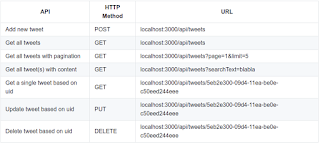
This post is about simple tweet api created using NodeJs and MongoDB. You can get a code from  Github link . Below REST APIs are provided. We need to have Node installed   before using this project. ExpressJS is used with MongoDB to store tweets.

TIBCO | Working with REST and JSON Plugin

Image
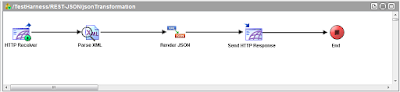
In this post we will check how to handle JSON datatype using TIBCO Designer. TIBCO Designer does not comes with built in JSON Palette in version 5.7.X. We need to install REST Plugin in order to use REST/JSON Palettes.  JSON  is lightweight datatype used in many systems mainly in web applications. JSON is lightweight as it does not require any XSD. We still can  use XML XSD in TIBCO to convert XML to JSON and vise versa. Activities : Render JSON - Converts XML data string to JSON String Parse JSON   - Converts JSON String to XML data string 

What is EAI?

Image
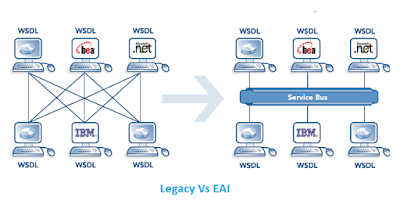
From Wikipedia's definition the Enterprise application integration (EAI ) is the use of software and computer systems' architectural principles to integrate a set of enterprise computer applications. But what it exactly mean? Before going to definition of EAI, think of legacy banking computer systems connected to each other in Ad hoc manner. Inventory component is storing large database of users. Accounting component manages complex calculations of end users. Front end components are consumed by bank officials and bank users. Each of this component is connected and requesting each other for information. Those components are used to connected point to point or one to many manner.